
INTRODUCTION - ANXIETY THERMOMETER FOR KIDS
An anxiety thermometer for kids is a simple visual tool that can help children recognise just how worried they are feeling before those feelings become overwhelming. For a child who struggles to explain anxiety in words, pointing to a number or colour can sometimes feel much easier than trying to describe everything happening inside them.
As a counsellor for many years, I worked with children who found it difficult to tell adults exactly what they were feeling. A child might say, “I don’t know,” become tearful, complain of a sore tummy or simply withdraw. Visual tools can give children another way to communicate when words are difficult.
The encouraging thing is that children can gradually learn to recognise their own warning signs and discover what helps them feel calmer.
In this article, I’ll show you how to use an anxiety thermometer for kids in 7 simple steps, so your child can begin recognising worry, talking about it and choosing gentle strategies to help themselves feel more in control.
What Is an Anxiety Thermometer for Kids?
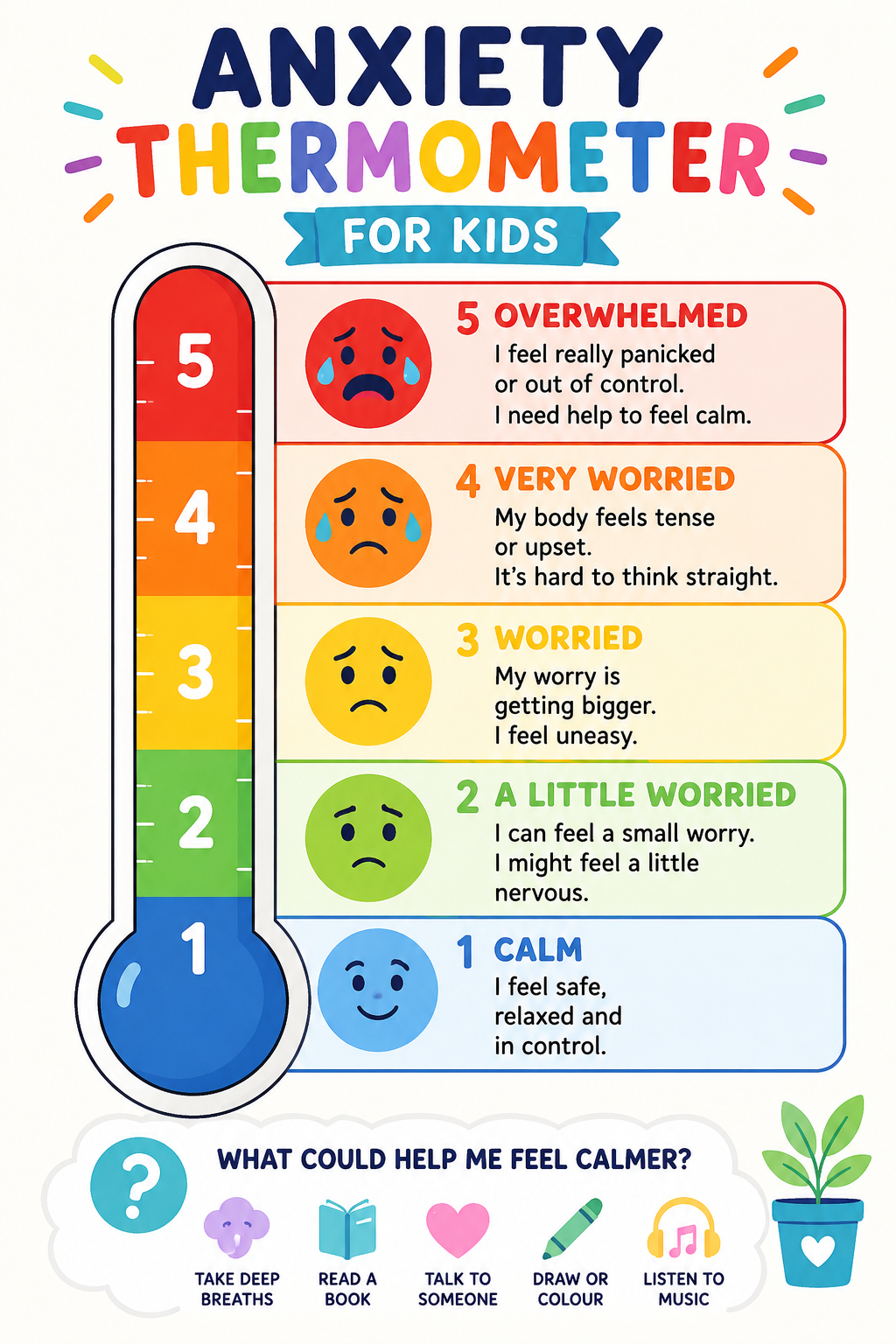
An anxiety thermometer is a visual scale that shows different levels of worry or anxiety.
Just as an ordinary thermometer measures temperature, an anxiety thermometer helps a child think about the intensity of a feeling.
For example, the thermometer might go from:
- 1 – Calm: I feel safe, relaxed and in control.
- 2 – A little worried: I can feel a small worry or nervous feeling.
- 3 – Worried: My worry is getting bigger and I feel uneasy.
- 4 – Very worried: My body feels tense or upset and it’s hard to think clearly.
- 5 – Overwhelmed: I feel panicked or out of control and need help to become calm.
The important thing is that there is no “bad” number.
A child reaching a 4 or 5 hasn’t failed. The thermometer is simply helping them communicate, “This is how big my worry feels right now.”
That information can help you decide together what your child needs next.
1. Introduce the Anxiety Thermometer When Your Child Is Calm
Try not to introduce the thermometer for the first time in the middle of a meltdown or highly anxious moment.
Instead, choose a quiet time when your child feels safe and relaxed.
You could sit together and say:
“Sometimes worries can feel little, and sometimes they can feel really big. This thermometer can help us work out how big your worry feels.”
Look at the different faces, colours and numbers together.
Keep the conversation light. You aren’t testing your child or expecting them to give the “right” answer.
The aim is simply to make the thermometer familiar so it is easier to use when worry appears.
2. Help Your Child Understand Each Level
Spend some time talking about what each number might feel like.
You could ask:
- “What does your body feel like when you’re calm?”
- “How do you know when a little worry is beginning?”
- “What happens in your tummy when you’re really worried?”
- “What thoughts do you notice when your worry gets very big?”
Children experience anxiety differently.
One child may get butterflies in their tummy. Another may feel hot, shaky or tearful. Some children become quiet, while others become restless, angry or clingy.
This is why an anxiety thermometer for kids becomes even more useful when you personalise it to your own child’s experiences.
3. Teach Your Child to Notice Their Body Clues
Anxiety isn’t only something children think—it can also be something they feel in their bodies.
Helping your child notice these physical clues can allow them to recognise worry earlier.
They might notice:
- A sore or fluttery tummy
- A racing heart
- Sweaty hands
- Tight shoulders
- Feeling shaky
- Wanting to cry
- Finding it difficult to sit still
- Feeling as though they need to escape
You might say:
“Your tummy feels funny and your hands are getting sweaty. I wonder where you are on your worry thermometer right now?”
This helps your child connect physical sensations with emotions without frightening them.
Over time, they may begin noticing the clues themselves.
4. Let Your Child Choose Their Number
Once your child understands the scale, encourage them to decide where they are.
Try not to choose the number for them.
You may think their anxiety looks like a 2, while to your child it genuinely feels like a 4.
You could gently ask:
“If 1 is calm and 5 is a really big worry, what number does your worry feel like?”
If they don’t know, that’s okay.
Give them time.
They might prefer to point to the thermometer rather than speak.
The goal isn’t perfect accuracy. The goal is helping your child become curious about their feelings and learn that it is safe to communicate them.
5. Match the Worry Level With a Calming Activity
Knowing the number is only the first part. Next, help your child discover what they can do with that feeling.
Different strategies may work at different levels.
For a small worry, your child might:
- Take several slow breaths
- Draw or colour
- Read a favourite book
- Listen to gentle music
- Cuddle a favourite toy
For a bigger worry, they may need:
- A calm adult nearby
- Fewer questions
- A quiet space
- Slow breathing together
- Reassurance and time to settle
You can find more ideas in my 10 Calming Activities for Kids That Actually Work, where I share simple and gentle ways to help children feel calm.
A Gentle Resource for Children Who Worry
If you’d like to continue supporting your child at home, my children’s book Murphy Helps with Worries gently introduces children to worries through Murphy’s story.
It can provide a natural opportunity for parents and children to talk together about what worry feels like and what can help when those feelings become big.
[my shop) LINK: Murphy Helps with Worries]
[AMAZON) LINK: Murphy Helps with Worries]
6. Practise Using the Thermometer Regularly
Children don’t have to use an anxiety thermometer for kids only when something is wrong.
Occasional everyday check-ins can help make talking about feelings normal.
For example:
“How are you feeling after school today—what number would you choose?”
Or:
“You were a little nervous before swimming. What number were you then, and what number are you now?”
This also teaches children something very important:
Feelings change.
A worry that feels like a 4 doesn’t stay at a 4 forever.
After talking, breathing, resting or receiving reassurance, they may notice it has dropped to a 3 or 2.
That can give children hope and help them recognise that they have strategies available when worry becomes difficult.
7. Praise Awareness, Not Just Calmness
It can be tempting to celebrate only when your child reaches number 1.
But there is something else worth praising: recognising and communicating the feeling.
If your child says, “I’m at a 4,” you might respond:
“Thank you for telling me. You noticed your worry was getting big. Let’s see what might help.”
This sends an important message.
Your child doesn’t need to hide anxiety to please you.
Instead, they are learning that difficult feelings can be noticed, talked about and managed with support.
That emotional awareness is a valuable skill that can continue developing as your child grows.
What If My Child Reaches Number 5?
If your child reaches the top of their anxiety thermometer, this is usually not the time for lots of explanations, questions or problem-solving.
First, concentrate on helping them feel safe and supported.
Stay nearby, keep your voice calm and use simple language.
You might say:
“I’m here with you. We don’t have to solve anything right now. Let’s help your body become calmer first.”
Once the intense feeling has passed, you can talk gently about what happened and what might help next time.
For another practical calming technique, you may also find 7 Simple Breathing Exercises for Children That Help Calm Big Feelings useful.
Create a Small Calming Plan Together
Once your child becomes familiar with their thermometer, consider creating a simple plan for each level.
For example:
Level 2: Take three slow breaths.
Level 3: Colour, read or sit somewhere quiet.
Level 4: Tell Mum, Dad, a teacher or another trusted adult.
Level 5: Stay with a trusted adult and focus on feeling safe and calming the body.
Your child’s plan doesn’t need to be complicated.
In fact, simple is often better.
You are helping them learn:
“When I notice my worry getting bigger, there are things I can do and people who can help me.”
Free Colouring Page download
Sometimes a quiet activity can give children a little space to settle after a difficult feeling.
I’ve created a free Murphy colouring page that your child can enjoy at home. Colouring can also provide a gentle opportunity to sit together and talk without putting pressure on your child to discuss their worries directly.
Final Thoughts – Anxiety Thermometer for kids
Children don’t automatically know how to identify anxiety. Learning to recognise worry and understand what is happening in their body takes time, patience and practice.
An anxiety thermometer for kids gives children a simple visual language for feelings that may otherwise be difficult to explain.
Start gently. Introduce the thermometer when your child is calm, practise using it occasionally and help them discover which calming strategies work best for them.
Most importantly, remind your child that every number is okay. The aim isn’t to feel calm all the time. It is to learn to recognise when worry is growing and know that there are safe, supportive ways to respond.
With your reassurance and practice, the anxiety thermometer for kids can become a simple everyday tool that helps your child understand their feelings and take small steps towards feeling calmer and more confident.


